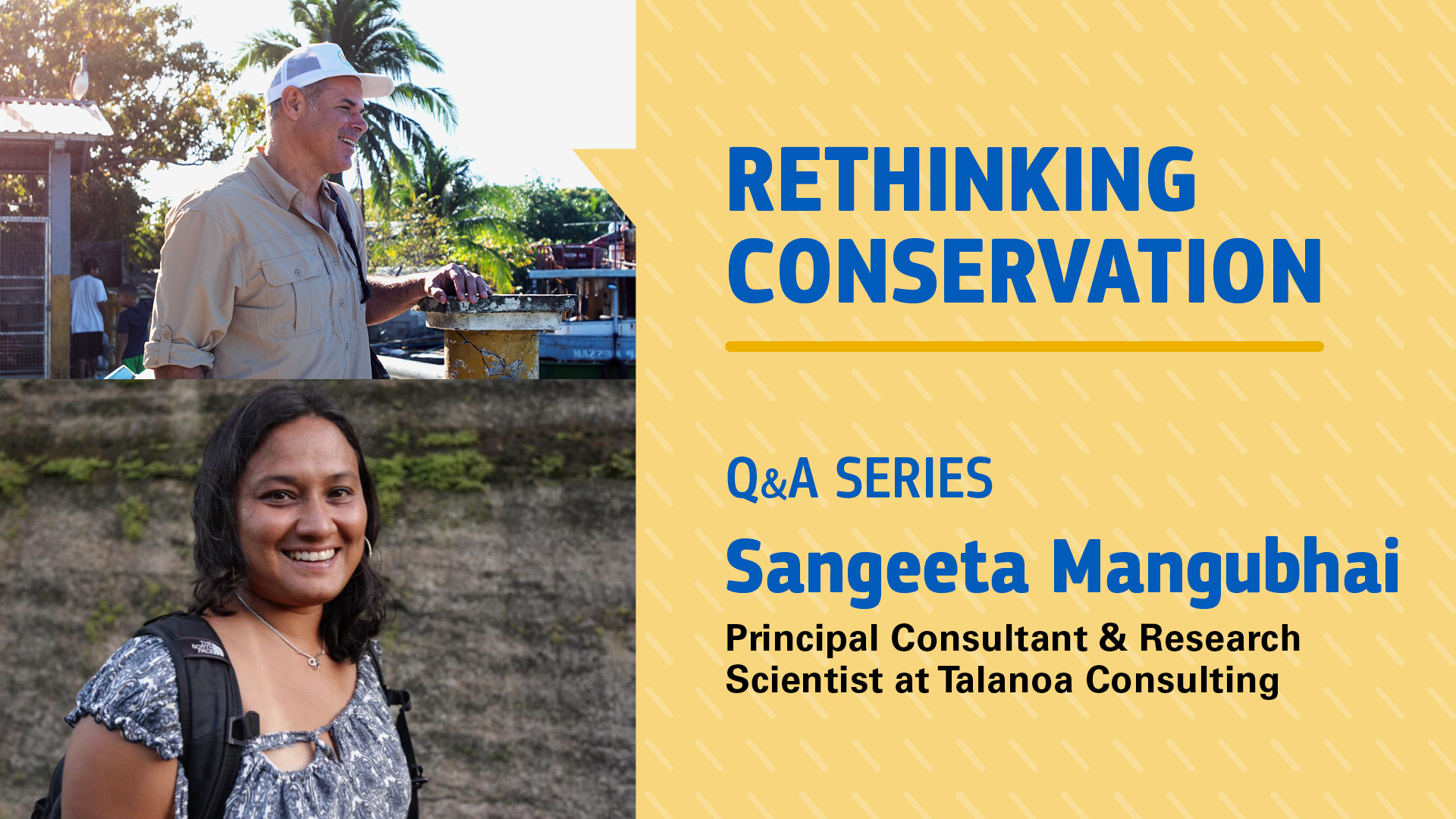
As global leaders rally around the goal of protecting 30% of the planet’s land and ocean by 2030, much of the conversation has focused on expanding marine protected areas. But for many coastal communities, especially those whose survival depends on small-scale fisheries, the path to conservation is far more complex.
Sangeeta Mangubhai has spent years working at the intersection of marine conservation, community rights, and fisheries management across the Pacific. As Principal Consultant and Research Scientist at Talanoa Consulting, Adjunct Researcher at the University of the South Pacific, and Editor of the SPC Women in Fisheries Bulletin, she has consistently challenged approaches that prioritize global targets over local realities.
In this conversation with Rare’s Caleb McClennen, Mangubhai discusses the risks of reducing conservation to a numbers game, why success must be measured by community well-being as much as biodiversity outcomes, and what more ethical, community-led marine conservation could look like.
***
Success means empowering communities to act as the primary agents of change, protecting resources on their own terms. – Sangeeta Mangubhai
1. Your recent paper challenges dominant interpretations of the 30×30 target, particularly the focus on expanding MPAs. What do you see as the most important misconception about 30×30 when it comes to small-scale fishing communities?
Sangeeta: The misconception is that designating 30% of marine areas as protected areas or OECMs is a universal solution, and that coverage area directly equates to conservation success.
The 30×30 target is politically attractive because it is easy to communicate and measure. However, it often promotes a narrow focus on area-based conservation that ignores the complex realities of coastal communities and what might actually suit them.
In some contexts, other management tools or interventions — such as fisheries management approaches — may be better suited and do a better job of protecting biodiversity.
Another concern is why local fishing communities should bear the burden of fulfilling global conservation commitments.
Caleb: Global targets can inspire local action, but it is clear they should not prescribe local action. The need for flexibility in determining what is effective conservation in various context is key.
2. Conservation success is often measured in area protected rather than outcomes for people. How should we redefine “success” in ways that genuinely reflect the well-being and rights of small-scale fishers?
Sangeeta: Redefining success means ensuring that marine conservation measures actively support the fundamental well-being and rights of small-scale fishers: food and income security, cultural identity, political empowerment, and access rights.
Success means empowering communities to act as the primary agents of change, protecting resources on their own terms.
Caleb: Not only does this redefinition help expand our sense of success, but also ensures both the adaptability and durability of conservation efforts for future times.

3. In practice, where do the biggest tensions arise between biodiversity goals and the livelihoods of coastal communities — and what does better decision-making look like when small-scale fishers are meaningfully included?
Sangeeta: The biggest tensions arise when top-down, externally imposed MPAs restrict or completely ban resource extraction in areas where people heavily depend on fisheries for basic survival and livelihoods.
Friction also occurs when formal conservation efforts undermine customary rights, effectively displacing Indigenous cultural practices that have sustainably managed fisheries for generations.
Massive tensions also emerge when governments demand local communities sacrifice their fishing grounds for conservation while simultaneously approving destructive, large-scale activities like logging, mining, or mass tourism nearby.
Better decision-making identifies, formally recognizes, and reinforces existing local initiatives — such as customary seasonal closures or Locally Managed Marine Areas (LMMAs) — instead of overriding them with Western conservation models.
It also involves co-creating ethical targets and holistic adaptation plans with communities to address the real threats they face, combining marine management with non-area-based measures to mitigate impacts like land-based pollution and other pressures threatening fisheries livelihoods.
Caleb: Real challenges across the conservation spectrum here. It is easy to tell the story of how conservation can be win-win. These examples and more challenge us to rethink our conservation assumptions. Not only will this be relevant in the policy formation phase, but long after as new pressures and needs emerge.
Sangeeta Mangubhai is Principal Consultant and Research Scientist at Talanoa Consulting, Adjunct Researcher at the University of the South Pacific, and Editor of the SPC Women in Fisheries Bulletin.
Follow Caleb McClennen on LinkedIn for more conversations with scientists, practitioners, and community leaders working to build a more people-centered and effective conservation movement.