
Series note: This article is part of Rare’s Rethinking Conservation series, which highlights people-centered solutions to the biodiversity and climate crises.
In this Q&A, Rare President Caleb McClennen, Ph.D., speaks with Elma Kay, who has spent two decades working at the intersection of conservation, land governance, and community stewardship in Belize. As Managing Director of the Belize Maya Forest Trust, she oversees one of the largest protected areas in Central America while working closely with neighboring communities to address growing threats from wildfire, land conversion, and climate change.
In this latest conversation, Elma reflects on the challenges facing the Belize Maya Forest and what community-led, behavior-centered conservation can offer a changing world.
The greatest opportunity lies in working with neighboring communities as partners in stewardship, both within their own lands and the reserve.
***
1. You’ve dedicated your career to conserving Belize’s remarkable ecosystems. What are some of the biggest conservation challenges facing Belize, or the Belize Maya Forest, right now?
Elma: With less than half a million inhabitants, Belize has established an extensive and diverse protected area system covering about 40 percent of its land territory and 25 percent of its ocean space. The country also remains almost 60 percent forested, thanks to the protection of additional Indigenous and private lands that are not formally designated as protected areas.
However, many of these protected areas, especially those owned by the Government of Belize, were designated when population growth and development pressures were low. Today, those pressures are increasing rapidly. There is growing demand for large stretches of land, sometimes within forest reserves, for industrial monocrop agriculture or cattle for export, urban and rural expansion, and tourism development. Climate change further compounds the impacts of deforestation and intensive agrochemical use.
Climate impacts include hotter and drier seasons and more frequent storms that affect terrestrial and aquatic ecosystems alike. At the macro level, one of Belize’s biggest challenges is the lack of an official land use vision, policy, and plan to guide development while protecting ecosystem services and ensuring equitable land distribution. I’ve seen three attempts to establish such a plan over the last two decades; the third is currently underway. But without a clear vision and plan, the governance of our protected areas system weakens, essential ecosystem services degrade, and there is rising inequality in the access to and distribution of lands for our citizens.
In the Belize Maya Forest, our most immediate challenges are wildfire and connectivity. Escaped agricultural fires — especially after hurricanes that leave heavy fuel loads — pose a growing threat. At the same time, deforestation is shrinking the Maya Forest Corridor, which connects us to the Maya Mountain Massif and the wider trinational Maya Forest (the largest contiguous forest north of the Amazon) that we share with Guatemala and Mexico. Losing that connection would put the long-term viability of wide-ranging mammals central to our natural and cultural heritage at risk.
Caleb: Elma, the patterns you describe regarding legacy conservation areas struggling with modern demographic, development, and climate pressures are relevant throughout the world. While the science of connectivity has long sought to inform land-use planning, I see that we, as a conservation community, still struggle to manage across different land-use types, especially when wildlife and threats don’t respect those political boundaries.
2. Given that wildfire has become an increasing threat across Belize and the wider region, what’s driving this trend, and how are conservation partners and local communities responding?
Elma: Fire has been used as a land management tool in Belize for thousands of years, dating back to our ancestors, the ancient Maya. However, climate change is driving more extreme and prolonged dry periods, which have dramatically increased fire risk across the country. Fire is now occurring in ecosystems, including moist broadleaf forests, that historically would have been too wet to burn.
Community stewards tell us that decades ago, these forests served as natural firebreaks. Today, fires can spread through them, sometimes traveling underground through extensive root systems. The result is forest degradation, acidic soils, and the rapid spread of invasive, fire-adapted vegetation — creating a vicious cycle that is difficult to reverse.
This pattern is most visible at the edges of the Belize Maya Forest and within neighboring communities, where fire threatens not only forests and wildlife but also human life and property. Our response, alongside other conservation partners, focuses on working directly with communities to promote safer fire practices and build local capacity for fire management.
Many of the communities we work with rely on farming, and avoiding fire entirely is often not feasible due to limited access to machinery and financial resources. Instead, we promote controlled burns under favorable conditions, the creation of fire lines with hand tools, close supervision of burns, and rapid response when fires escape. In non-farm areas, these practices can also address risks associated with garbage burning, especially plastics, and inadequate solid waste management, which can easily lead to escaped fires and health hazards. One new thing we are incorporating into our work is helping communities find solutions to reduce their plastic use.
Caleb: You make a clear point that wildfire, like so many conservation threats, cannot be solved through prohibition alone. Fire use is a long-standing livelihood and land management practice that, when stewarded well, can balance cultural tradition, livelihoods, and growing climate risk. Conservation strategies that have focused only on preventing so-called “bad” activities or behaviors, rather than working with communities to understand and help them shape the social norms and incentives that support stewardship, have too often fallen short.
3. The Belize Maya Forest Trust manages one of the largest protected areas in Central America. Where do you see the greatest opportunities to approach wildfire and forest management differently in this landscape?
Elma: The greatest opportunity lies in working with neighboring communities as partners in stewardship, both within their own lands and the reserve. Earlier in my career, I helped develop participatory conservation and sustainable management plans and always hoped to focus more on implementation. At the Belize Maya Forest Trust, that is precisely what we do through our community stewards program.
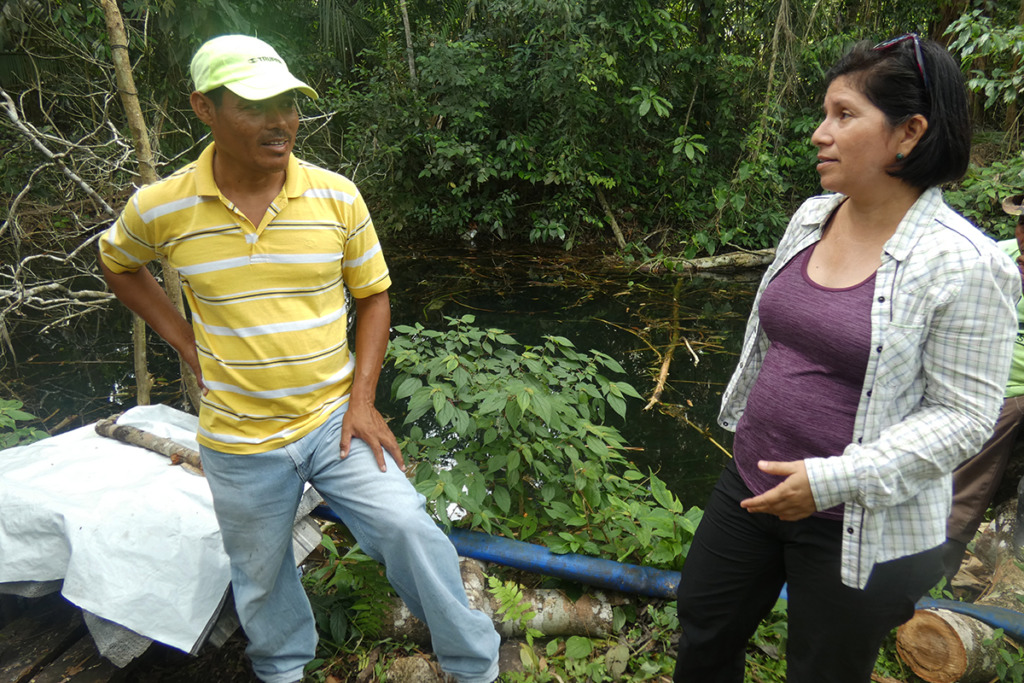
Since our establishment over five years ago, we have prioritized building relationships — getting to know communities and allowing them to get to know us — before determining how best to work together. Participation is flexible, inclusive, and multigenerational, with opportunities for youth through scholarships, families through microgrants for sustainable livelihoods, and entire communities through restoration projects such as riparian zone recovery.
We also work directly with farmers on climate-smart and regenerative practices, including agroforestry, cover crops, and safer fire use. Many community stewards assist with restoration, research, monitoring, and fire suppression during the dry season, and some serve as part-time rangers. Equally important is creating spaces for stewards to connect, fostering unity and continuity across communities and the broader landscape.
Caleb: You highlight stewardship as both a technical and social endeavor, built through long-term relationships and shared responsibility. It’s heartening to see that so much of what you detail here aligns with Nobel Laureate Elinor Ostrom’s principles for managing ‘the commons’ and with our own Roadmap for Collective Action.

4. You’ve begun applying Rare’s behavior-centered design approach to your work. What excites you about this way of tackling challenges like wildfire management?
Elma: We are working with Rare to build the capacity of our team, communities, and partner organizations to apply behavior-centered design approaches. What excites us most is your flexibility and adaptability to local contexts. These approaches allow us to move at the pace of trust and co-create solutions through dialogue, collaboration, and testing — rather than imposing our own assumptions.
Behavior-centered design helps us surface biases, validate or challenge our intuition with evidence, and uncover insights that lead to more creative solutions. Internally, it has helped us better integrate our community, protection, and science programs, reducing silos and duplication.
Our most advanced application has been in safe fire use campaigns. Insights from interviews and focus groups led us to redesign training materials and delivery, bringing entire families and previously disconnected groups into fire management efforts. In some communities, hands-on burning alongside farmers has proven more effective than formal workshops.
Caleb: As you’re describing it, behavior-centered design emerges here as a mindset that values humility, learning, and co-creation over prescriptive solutions. I know the approach has been used in fire management before. Still, given the growing threats to conservation posed by fires, I’m looking forward to seeing the results of this work and its potential for replication in other tropical forest locations. To that end…
5. How might the lessons emerging from Belize around drought, fire, and community-led conservation inform efforts to strengthen resilience and biodiversity elsewhere in the world?
Elma: One of the most important lessons we’ve learned is that there is no one-size-fits-all solution, even within Belize or the Belize Maya Forest. Each community has its own history, dynamics, and realities, and without trust, there can be no community-led conservation.
Trust is built by consistently showing up, listening, and being transparent about long-term objectives. For the Belize Maya Forest Trust, it took more than two years to begin understanding local motivations and barriers around fire. After five fire seasons, we achieved our goal of preventing fires in the reserve’s broadleaf forests and are continuing to improve practices across the surrounding landscape. We hope to keep amplifying the latter through our behavior-centered approaches, in collaboration with Rare.
Another key lesson is that co-creation must be accompanied by flexibility and reciprocity. Without reciprocity, there is little ownership of actions and, by consequence, little sustainability and long-term stewardship. One restoration effort evolved into both tree planting and the construction of a small community health post — linking forest restoration with human well-being. That reciprocity has strengthened ownership, stewardship, and long-term commitment. We are also adopting this co-creative, flexible, and reciprocal approach with other community efforts.
Caleb: These lessons point to resilience as something built through relationships and sustained over time through trust, reciprocity, and shared value. It’s impressive that, under your leadership, the Belize Maya Forest Trust has achieved these successes.
The world has a lot to learn from your experience. Rare is lucky to have you as a partner!
Follow Caleb McClennen on LinkedIn for more insights into Rethinking Conservation.