(May 21, 2026—Koror, Palau) In an important step for coastal resource management in Palau, leaders from the eastern communities of Melekeok and Ngiwal have formally signed an agreement to strengthen coordination around marine conservation and fisheries management. It is the first such regional alliance to coordinate regional marine conservation. The partnership marks an important step in expanding the community-led, coastal resource management efforts already underway in Palau. By signing this partnership agreement, the states help ensure that their shared marine ecosystem is supported by shared political governance.
The agreement was formalized during a stakeholder event at Palau’s Capitol on May 19, 2026. The event brought together Governor Polloi of Melekeok, Governor Melaitau of Ngiwal, state legislators, community leaders, fishers, and partners to advance the next stage of Safeguarding Palau’s Coasts: Traditional Knowledge and Community Leadership for Coastal Protection, a project supported by Rare.
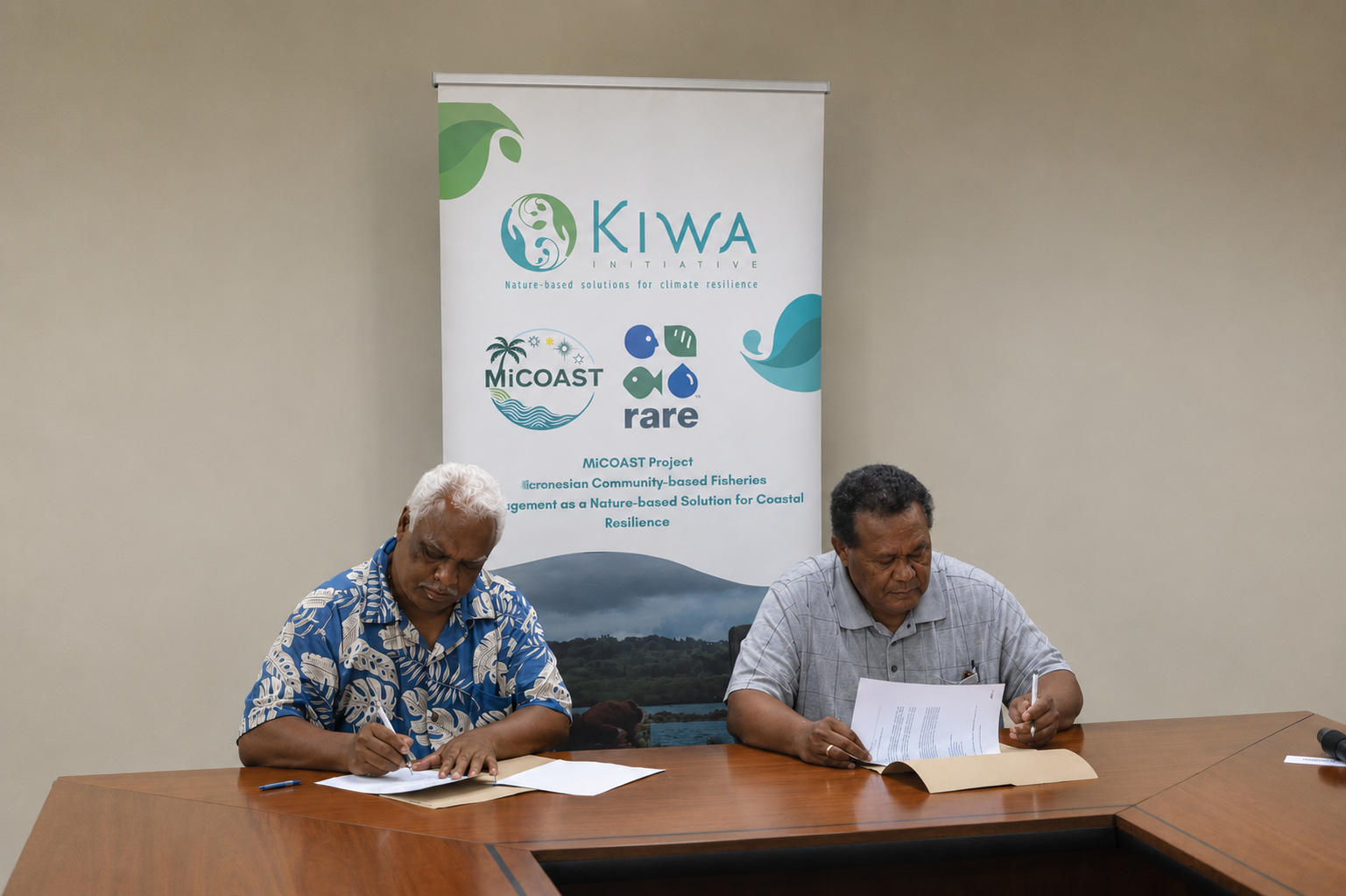
“The launch of this partnership is a commitment to the fishing communities of Melekeok and Ngiwal,” said Kevin Mesebeluu, a senior program implementation manager at Rare—an international NGO specializing in community-led conservation. “Partnerships like this help ensure Palau’s natural ecosystems will continue to thrive, and sustain the food security, livelihoods, and resilience of our communities in the face of climate change. We hope this agreement sparks similar agreements between state governments and advance Palau’s collective effort to protect the ocean.”
Preliminary research conducted by Rare and local partners—including biophysical assessments, household surveys, and the documentation of traditional ecological knowledge (TEK)—was presented and validated at the May 19 event. These tools are all part of Rare’s Fish Forever Program, which seeks to establish a network of Managed Access and Reserves (MA+R) as a means of sustainable fisheries management and climate resilience in the face of climate change.
Core to this project in Palau is the concept of combining traditional Bul practices with modern scientific assessments, informing and enhancing the protection of coastal waters and the communities that depend on them. For centuries, Palauan communities have shared long-standing customary practices around seasonal fishing, fish runs, community resource management, and cooperative stewardship that have successfully sustained coastal ecosystems.
By combining these time-honored practices with the scientific assessments that reaffirm the interconnectedness and critical importance of Palau’s coastal ecosystems, communities are better equipped to address the overlapping environmental and fisheries management challenges they face today. This integrated approach also underscores the growing need for stronger coordination and collaboration among coastal communities to ensure the long-term health and resilience of Palau’s marine resources
Beyond endorsing Rare’s community-led approach, the partnership also plays a major role in implementation as it provides political backing for coastal policies, joint surveillance, and the co-management of shared fisheries. As Governor Melaitau of Ngiwal said during the ceremony while speaking on reef recovery efforts, “We are stronger when we (the states of Melekeok and Ngiwal) work together.”
Notably, the project reflects momentum in the broader policy landscape, as it aligns with the newly endorsed Coral Reef Action Plan for Palau led by The Nature Conservancy. Both governors have also now joined Rare’s Coastal 500 Network, a global coalition of coastal leaders committed to thriving and prosperous coastal communities and ecosystems.
The Kiwa MiCOAST project (short for “Micronesian Community-based Fisheries Management as a Nature-Based Solution for Coastal Resilience”) is a three-year initiative that aims at advancing Community-Based Fisheries Management and Nature-based Solutions across a large portion of the Micronesia region, spanning the Marshall Islands, Nauru, Kosrae, Pohnpei, Yap, and Palau. The Kiwa Initiative – Nature-based Solutions (NbS) for Climate Resilience aims to build the resilience of Pacific Island ecosystems, communities and economies to climate change through NbS by protecting, sustainably managing and restoring biodiversity. It is based on simplified access to funding for climate change adaptation and biodiversity conservation actions for local and national governments, civil society and regional organisations in Pacific Island States and Territories. The Initiative is funded by the European Union, French Development Agency (AFD), Global Affairs Canada (GAC), Australia’s Department of Foreign Affairs and Trade (DFAT), and New Zealand’s Ministry of Foreign Affairs and Trade (MFAT). It has established partnerships with the Pacific Community (SPC), the Secretariat of the Pacific Regional Environment Programme (SPREP) and the Oceania Regional Office of the International Union for Conservation of Nature (IUCN). For more information: www.kiwainitiative.org.
###