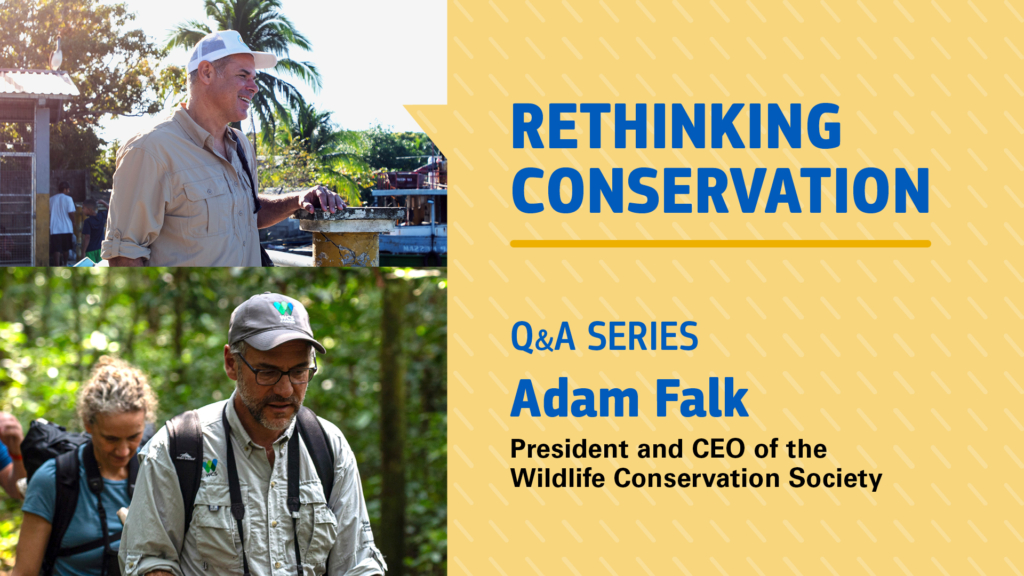
Rethinking Conservation is a conversation series that explores new ideas, unexpected perspectives, and fresh thinking about the future of conservation. Through conversations with leaders from inside and outside the field, the series challenges assumptions and explores what it will take for people and nature to thrive together.
Adam Falk began his tenure as President and CEO of the Wildlife Conservation Society (WCS) in 2025 after a career leading major mission-driven institutions in higher education and philanthropy. A theoretical high-energy physicist by training, Falk brings a deep background in science, philanthropy, and institutional leadership to conservation. Though relatively new to the sector, he brings a fresh perspective to some of conservation’s biggest questions: what inspires people to care about nature, how science drives impact, where conservation organizations need to evolve, and what lessons other sectors can offer.
In this conversation with Rare’s Caleb McClennen, Falk reflects on his first year in conservation and shares why he believes protecting nature is ultimately about values, collaboration, and embracing the complexity of people.
***
Conserving nature is fundamentally about values, not microeconomics. Let’s not assume we have to financialize nature to save it.”
1. What unlocks people’s desire to care about wildlife and the natural world? And what inspired you to commit this chapter of your career to conservation?
Adam Falk: I really believe that contact with wildlife and nature is a three-dimensional, embodied experience. It is foundational to inspiring people. We spend so much time in this modern world with mediated experiences of one kind or another, where we somehow think that enhancing the quality of that mediation makes things better. But the truth is that we are animals ourselves, and contact with wildlife and nature is a visceral experience. It is not primarily an intellectual experience, and I think that is what inspires people.
It is certainly what has inspired everyone I know who loves conservation.
Sometimes people who love nature do not even think of themselves as conservationists until it’s pointed out to them. I have loved hiking my whole life. I love being in nature. I love being in the mountains. Until I came to WCS, though, I wouldn’t have thought of that as conservation. Still, it clicked for me immediately when I got here that the thing I love about being in nature is the same thing conservationists love.
The other thing I have come to appreciate deeply is that conservation is at its heart an ethical practice. It is not fundamentally based on a cost-benefit analysis of what we get from nature or what we might lose economically if we do not have it. It is about valuing nature the way we value human life.
As much as we may need to make economic arguments from time to time, that is not why we protect wildlife and wild places. We do it for foundationally moral reasons. To me, that is deeply inspiring.
Caleb McClennen: I love that framing. The idea that people often connect emotionally to nature long before they identify as conservationists feels incredibly true. In many ways, we’re all conservationists, whether we realize it or not. That’s one reason I think zoos and aquariums play such an important role. They create those visceral, personal connections to wildlife that can spark a lifelong commitment to conservation. Those experiences help people see themselves as part of the story.
2. In your first year in conservation, what worked better than you expected? What’s been harder to shift than you thought?
Adam Falk: I am still learning, so these are provisional answers.
Something that works better than I expected, and is deeper than I expected, is the work conservation organizations do with Indigenous Peoples and local communities. As an outsider to the profession, I had not fully appreciated what that looks like in practice, or how successful it can be.
Some of my most meaningful field visits have included time with Indigenous communities in places like Guatemala and the Republic of Congo. Seeing wildlife is extraordinary, of course, but close behind that is seeing how conservation organizations align conservation goals with the economic and cultural realities of the people who live in these places.
I have been struck by how thoughtfully and respectfully that work is done. I now see it as foundational to successful conservation and to the sustainability of our work.
What’s been harder is figuring out how to align the incentives of the global financial system with conservation’s needs.
There are many ambitious and visionary ideas around carbon markets, biodiversity credits, conservation finance, and other innovative mechanisms. But I don’t yet see enough examples of real successes. I think we can be drawn to these strategies because of a desire to scale, whatever that may mean in practice. I worry that this desire can also at times make us susceptible to wishful thinking and, even worse, cause us to lose touch with the critical work that we do in the field.
We have to pursue those ideas without letting them supplant the real conservation work that we do.
Caleb McClennen: Agree. While we may all want solutions that can scale, there is an important difference between ambition and proven impact.
3. WCS is known for its leadership in conservation science. How can science help accelerate conservation impact?
Adam Falk: Science being so central to WCS is one of the things that drew me to the organization.
When I refer to using science, I simply mean observing and studying the world, conducting dispassionate analysis, and then using what is learned to guide decisions about what to do next. In that sense, solid science is what drives effective conservation strategy.
I’m reading George Schaller’s biography, Homesick for a World Unknown, and there’s a great example from his tiger research in India about this. His key insight was that if you wanted to save tigers, you actually had to focus on protecting their prey.
Today, that sounds obvious. But at the time, it wasn’t. People were focused on protecting tigers directly, rather than understanding the ecological systems that supported them. Schaller’s insight emerged from the applied science he did in the field — the careful observation, rigorous data collection, and careful and creative thinking about what the data meant. His scientific work fundamentally changed how people thought about tiger conservation.
We continue to see similar opportunities today, though often with very different tools. For example, WCS leads on MERMAID, a collaboration using citizen science, large-scale data analysis, and AI-powered image recognition to identify climate-resilient coral reefs and address scientific questions that are crucial to saving them.
The technologies may be different, but the goal is the same: using science to better understand the systems we’re trying to protect. We want to stay on the cutting edge of those tools because they allow us to do our work better, not simply because they’re the latest thing.
Caleb McClennen: Agree! The best science often changes how we see the problem itself.
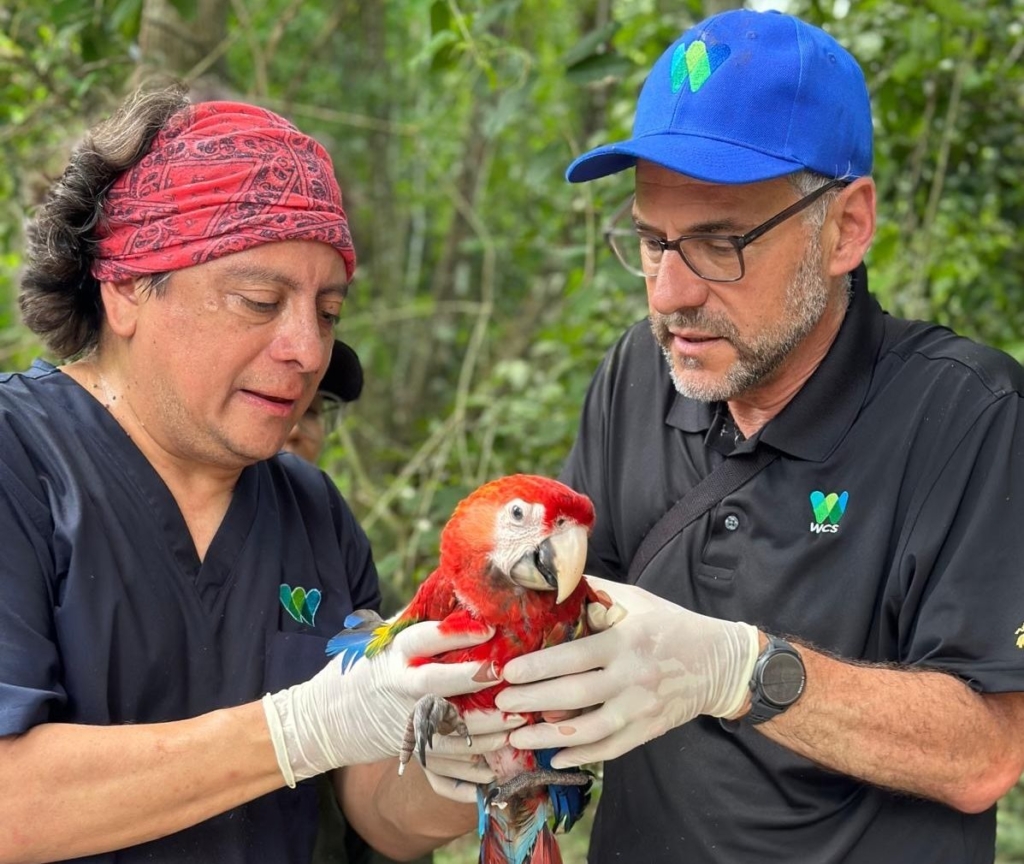
4. If you could redirect one major assumption in conservation today, what would it be?
Adam Falk: Conserving nature is fundamentally about values, not about microeconomics. I think our own authentic motivations for doing this work — a love of nature, wild places, animals — are the most powerful and motivating for the people we need to convince to support it. We should not be afraid to say that clearly.
For example, it’s easy to assume that donors from the finance world will be motivated primarily by financial solutions to conservation problems. But in fact, I think what motivates and inspires them is the same thing that inspires me and other conservationists.
Let’s not assume we have to financialize nature in order to save it.
Caleb McClennen: I couldn’t agree more. Too often, we assume people need an economic rationale to care about nature. In my experience, whether we’re talking with donors, policymakers, or community leaders, what often motivates action is the same thing that motivates conservationists: a genuine connection to the natural world.
5. What do conservation organizations need to rethink to remain effective?
Adam Falk: One thing that has struck me is just how many organizations are working on conservation. That is a fantastic thing.
But I also think it is too easy to see ourselves as competitors, particularly over resources. The reality is that we are all trying to save the same planet.
We need to emphasize collaboration and complementarity. We are not all trying to solve the same problems in the same ways, and we do not all need to do everything. We need to make space for organizations whose approaches complement our own and recognize that we are stronger together.
I think conservation is already good at this. But we need to become even better at it, especially in light of the acute crises we all face.
Caleb McClennen: The challenges we face are too large for any one organization to solve alone. One of the great privileges of my time at WCS was helping lead partnerships ranging from the Shark Conservation Fund and 50 Reefs to conservation technology initiatives and the Intact Forest Alliance. Those experiences reinforced for me that conservation outcomes are almost always stronger when organizations bring complementary strengths to the table. That’s one reason I’m so enthusiastic about the growing partnership between Rare and WCS, from biodiversity prioritization and MERMAID to small-scale fisheries and a range of country- and regional-level collaborations.
6. What lessons from outside conservation should the field adopt?
Adam Falk: Two things come to mind.
The first is that we need to respect and invest in the administrative work that makes organizations run well.
In mission-driven organizations, people are understandably motivated by outcomes. They care about wildlife, wild places, students, communities, or whomever their mission calls them to serve. But that can sometimes lead to undervaluing the people and systems that make the work possible.
What is HR, if not making sure you hire and retain the best people? What is accounting, if not ensuring that your scarce resources are used effectively and responsibly? What is communications, if not helping the world understand why your work matters?
These functions are not distractions from the mission. They are what enable the mission.
The second lesson is that we should embrace the complexity of people and their motivations.
Donors, supporters, policymakers, Indigenous communities, local communities — people are complicated. They are not always going to share all our values. They are not always going to say exactly what we want them to say.
But if we can find common ground and build from it, we can create much larger coalitions for conservation.
The challenges we face are too important and too difficult for us to subject our collaborators to superfluous purity tests. We need to be willing to work with people who agree with us on some things, even if they do not agree with us on everything.
In my experience in higher education, bringing that mindset into institutions makes them stronger. My instinct is that it will strengthen conservation organizations, too.
Caleb McClennen: I know that my Operations Team is going to love hearing that perspective, Adam!
What strikes me throughout this conversation is that many of the most important conservation challenges are ultimately human challenges. Whether we’re talking about connecting people to nature, grounding our work in strong science, or building the partnerships needed to achieve lasting impact, your reflections offer a valuable reminder that conservation starts with values.
Thank you for helping us rethink some of the assumptions that shape our field.
Adam Falk is President and CEO of the Wildlife Conservation Society (WCS). Prior to joining WCS, he served as President of the Alfred P. Sloan Foundation, President of Williams College, and Dean of the Zanvyl Krieger School of Arts and Sciences at Johns Hopkins University, where he was also a professor of physics. At WCS, Falk oversees five iconic zoological parks in New York City — the Bronx Zoo, Central Park Zoo, Prospect Park Zoo, Queens Zoo, and the New York Aquarium — and supports field conservation programs in more than 55 countries.
Follow Caleb McClennen on LinkedIn for future conversations and join us in rethinking what it will take for people and nature to thrive together.
This article has been edited and condensed for clarity.