
In Kenya, more than 65% of wildlife lives beyond the boundaries of government-protected national parks. Over the last fifty years, community conservancies have become central to protecting wildlife corridors while ensuring communities retain the right to manage their ancestral lands. Today, more than 40 community conservancies anchor this movement in northern Kenya.
Their expansion traces back to one leader. Titus Letaapo, a former schoolteacher from the Samburu Indigenous community, applied Rare’s behavior-centered approach to conservation in his home conservancy. What began as a locally rooted effort to restore habitat and strengthen livelihoods became a replicable model for Indigenous-led conservation across an entire region.
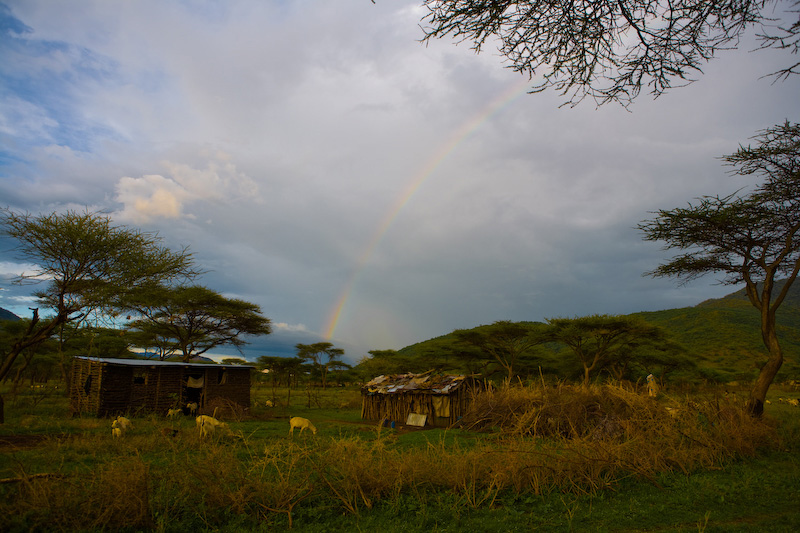
Before becoming a renowned conservation leader, Titus was a boy herding cattle beneath the Mathews Mountain range in northern Kenya. As a member of the semi-nomadic Samburu community, he grew up with a deep kinship with wildlife that shaped his identity and traditions.
“We viewed wildlife not as a resource to benefit from, but as a gift from God,” says Titus. “Some clans even have names related to wildlife. Myself, I’m an elephant family. We treasure elephants and view them as family.”
But the 1980s brought new pressures. Regional instability fueled poaching and trophy hunting across northern Africa. Titus remembers the conflict reaching a climax when conservationist Ian Craig witnessed the killing of 16 elephants in one incident.
The tragedy forced a reckoning. Ian raised the issue with the Samburu East member of Parliament, Honourable Sammy Leshore, and proposed establishing a community conservancy to legally protect local wildlife. The idea was met with hesitation, especially among youth, who had heard how Kenya’s national parks and protected areas often displaced Indigenous communities and excluded them from decisions about their ancestral lands.
“We knew that in a protected area, there’s no accessibility, there’s no grazing — the land is often taken away from the community,” shared Titus, who was working as a primary school teacher at the time. “So, all of us, including those of us who were educated, didn’t support it.”
Turning pride into collective action
In its early years, Namunyak Community Conservancy grappled with a familiar tension: how to balance economic livelihoods with ecological health. Overgrazing strained pasturelands. Traditional honey harvesting and charcoal production, often reliant on open flames, sparked unintended wildfires. Wildlife habitat was quietly degrading.
In 1999, Namunyak hired Titus as Assistant Manager to strengthen conservation knowledge among youth and the broader community. After further training in natural resource management at the South African Wildlife College, he returned home committed to deepening community engagement.
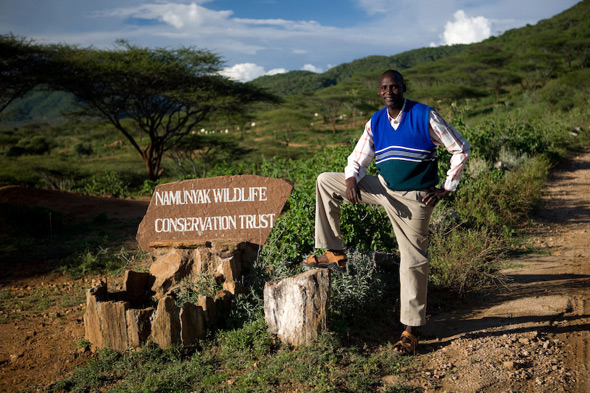
A program lead encouraged him to apply to Rare’s Pride Campaign program for training in how to mobilize communities around conservation. With Rare’s guidance, he launched a campaign to address overgrazing and protect critical wildlife habitat. He selected the greater kudu as the flagship species: a large antelope revered by the Samburu for its ceremonial horns. Overgrazing had severely degraded the animal’s habitat, and local kudu populations were declining across the region.
“The land the greater kudu used was the same land the buffalo used, and the same land community livestock depended on during periods of drought. But people didn’t realize that this habitat was slowly disappearing,” says Titus.
Balancing modern conservation methods with Indigenous knowledge required delicate navigation. Within the Samburu community, where traditions ran deep, conservation messaging risked being seen as externally imposed. At the same time, many community members were facing dire losses due to drought and livestock predation, making it difficult to promote wildlife protection when daily livelihoods were under strain. Titus knew the campaign would only succeed if it reflected the community’s identity and culture.
“From the start, all through the campaign, everybody was fully engaged — the boards, the government, and the community,” says Titus.
When asked about his favorite memory, Titus recalls bringing schoolchildren to visit patients at Wambu Hospital. Dressed in greater kudu costumes, the children sang wildlife songs, acted out plays, and shared treats made by a local women’s group.
“The patients laughed until they forgot they were sick. I can still remember that day,” he shares fondly.
Alongside the celebrations came measurable change. Honey harvesters adopted safer techniques that eliminated the need for open flames, reducing forest fires from 14 in 2006 to just one in 2007. A grassland management committee trained more than 50 community members in sustainable grazing practices. Together, they designated a core conservation area that restricted grazing to conserve habitat for local wildlife while preserving a reserve pasture for extreme drought.
“Prior to Rare, I was managing an institution, but I did not know the approach to engage communities in conservation,” says Titus. “Rare changed my approach to creating awareness at all levels.”
Creating a legacy of community-owned conservation
The transformation did not go unnoticed.
Just as Samburu elders had once taken Titus to the Maasai Mara, Titus began hosting delegations from neighboring communities. Visitors could see restored habitat, functioning grazing committees, and community members actively stewarding their own lands.
“Once community members accepted the model, we supported them in establishing their own ownership structure and mapped out the actions needed in the first month, first year, and beyond,” he says.
Drawing on the same principles of shared identity, visible leadership, clear early wins, and structured governance, Titus helped replicate the model across Kenya. Over time, he established more than 40 community conservancies across northern Kenya, each led and managed by local communities. What began as one behavior-centered initiative had evolved into a regional system of community-owned conservation.
After years of supporting new conservancies, Titus returned to Namunyak in 2019 and joined the Sarara Foundation as Director of Community, helping shape a self-governance model rooted in local leadership.
“We don’t want to see wildlife secluded from us,” explains Titus. “We want the community to say, ‘Namunyak is ours. I participate in everything that needs to be done.’”
Nearly three decades after its founding, Namunyak stands as proof that conservation can endure when communities lead it. Rooted in identity, reinforced by shared norms, and strengthened through local governance, the model has supported both ecological recovery and community self-determination.
And as for Titus, his conservation story is far from over. He now hosts delegations from nations worldwide, connecting Indigenous communities facing similar pressures from climate change and land degradation.
“It’s important that communities understand they are not living in isolation,” he says. “I think it is especially important to scale the pride approach to Indigenous community areas. If you look at what I’ve done myself, the approach didn’t only solve the greater kudu threats. It helped us address all of our interconnected conservation challenges.”
Written by: Kaila Ferrari
Edited by: Larissa Hotra
Photos: Jason Houston