Rare at COP17
Scaling community-led solutions to deliver the Global Biodiversity Framework
From October 19 – 30, 2026 more than 18,000 delegates from 196 countries gathered in Yerevan, Armenia for the 17th UN Biodiversity Conference (CBD COP17).
Slated as the halfway point to 2030, COP17 marked the first global review of progress since countries adopted the Kunming-Montreal Global Biodiversity Framework (GBF) in 2022 – a critical test of whether commitments are turning into results. COP17 confronted the gap between commitment and delivery: strengthening synergies across climate and biodiversity action, accelerating progress towards 30×30, the recognition of Indigenous Peoples’ and local communities’ rights and governance, and closing the biodiversity finance gap that stands between ambition and impact.
Beyond the negotiations, Rare and Coastal 500 focused on strengthening support for community-led solutions to address conservation challenges. Communities around the world are already designing and delivering the conservation solutions called for in the Global Biodiversity Framework and COP17 was an opportunity for these solutions to be at the center of how the world finances and scales conservation. This recap highlights key moments from Rare’s engagement with diverse stakeholders across nearly 40 events.
Global Review & National Biodiversity Plans
COP17 was the first time the CBD formally assessed collective progress against the GBF’s 23 targets, drawing on countries’ updated National Biodiversity Strategies and Action Plans (NBSAPs).
The adopted Yerevan Pathway singles out the gap in marine, coastal, and inland water ecosystems – where coverage is furthest behind – as a priority for the remaining years. Parties adopted an updated Programme of Work on Protected Areas, bringing the CBD’s 2004 roadmap for protected areas in line with the GBF and Target 3. It adds activities on equitable governance and recognizing the rights and contributions of Indigenous Peoples and local communities, on monitoring management effectiveness, and on ecological connectivity between conserved areas.
Today we face a tremendous gap between the funds we need for conservation in the world’s most vulnerable places, and the actual money currently being invested. Philanthropy is essential but falls short of what is required. At COP17, Rare will showcase innovative solutions that bring together public, private, and philanthropic capital and channel it toward the frontlines of conservation and climate change.
Global commitments on biodiversity and climate are made in conference halls, but their success depends on what happens in our communities.
Local leaders around the globe call for greater interconnectedness between Biodiversity & Climate COPs.

30×30 & OECMs
Target 3 – protecting 30% of terrestrial and marine areas by 2030, better known as 30×30 – has been the most highly funded and focused-upon target of the GBF. The Ocean Protection Gap Report, launched ahead of COP17, highlighted the implementation gap that oceans face on the pathway to 30×30:
- About 10% of the ocean is designated for conservation, but only ~3.5% is fully or highly protected. Within national waters ~22–23% is protected; on the high seas, just ~1.5%.
- If fully delivered, current national commitments would protect only ~26% of land and ~12% of the ocean by 2030.
To address the gap, Rare delegates spoke throughout the conference on the recognition, reporting, impact, and effectiveness of Other Effective area-based Conservation Measures (OECMs), a conservation tool deployed by governments to protect ecosystems, while allowing for their sustainable use by Indigenous Peoples and Local Communities.
- Making 30×30 count: From participation to credible, equitable and lasting marine OECMs in Asia
An event co-hosted by the Asia OECM Community of Practice, the IUCN WCPA, and ReefCheck Malaysia focused on accelerating the identification, effective management, and reporting of OECMs across Asian countries, and ensuring OECMs are not only about coverage, but also about quality, equity, and effectiveness on the ground.
- Global concept, local proof: Who decides what counts as an OECM?
During an event focused on the evidence of the impact of OECMs, Rare Indonesia VP Hari Kushardanto connected credible evidence — community monitoring, citizen science, academic research, official data, or some combination – with good governance. - Additionally, the COP17 Presidency launched a Global OECM Action Hub with the CBD Secretariat, FAO, and IUCN, to help countries identify and recognize OECMs. The Hub will pool expertise and support consistent application of existing criteria, rather than set new standards.
Caleb McClenne, Rare President & Pamela Castillo, WCS Director of Marine 30×30
How MPAs and OECMs can together deliver effective and inclusive ocean protection.
Protecting at least 30% of the ocean by 2030 requires more than expanding marine protected areas. It also means recognizing and meaningfully supporting the communities already leading ocean conservation.
Indigenous Peoples, Local Communities & Human Rights
Indigenous Peoples and local communities steward vast areas of the world’s lands and waters yet outdated “fortress conservation” models have historically excluded or evicted them from the territories they have long cared for. COP17 was where commitments were to be put into practice.
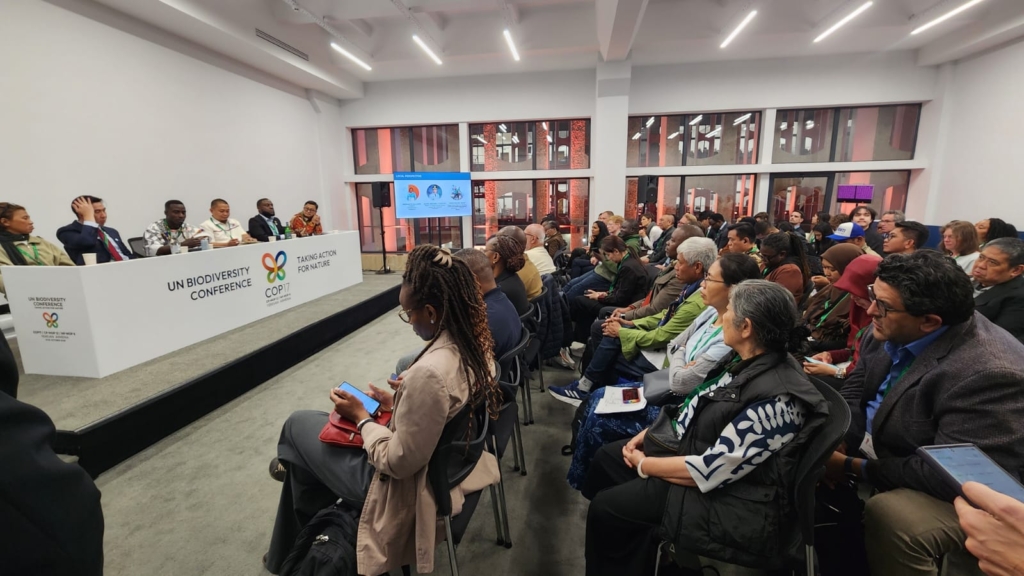
Coastal communities are already helping turn global biodiversity commitments into action. But their ability to sustain that work depends on rights, resources, and representation. This was the message delivered by local and national leaders from the Philippines, Indonesia, Ghana, and Mozambique during our COP17 side event.
“Local communities are not just beneficiaries of conservation; they are its frontline guardians.”
Bupati Michael Thungari, Member of Coastal 500, Sangihe Islands, Indonesia
Getting finance to the frontlines
Finance was the central fault line of COP17. Under the GBF, developed countries committed to provide at least $20bn per year in international biodiversity finance by 2025 and $30bn by 2030, with $200bn per year mobilized from all sources. The 2025 milestone was missed – OECD data suggest roughly $16bn per year over 2023–25 – amid sharp cuts to overseas development aid, and environmental funding for 2026–30 is projected to fall 27%.
With public finance falling short and negotiations stuck on who pays, the question for communities on the frontlines is not just how much money is raised, but whether it reaches them.
At COP17, Rare hosted an Ocean Pavilion reception exploring how to move more money to ocean conservation with a pay-for-results approach. The reception introduced Deep Blue, an outcomes-based financing platform developed by Rare in partnership with ORRAA and Levoca and designed to help governments, philanthropies, and private investors pay for measurable, independently verified ocean outcomes.
John Whalen, VP of Innovative Finance
On Tapping New Funding Sources for Conservation
John Whalen, Vice President of Innovative Finance at Rare, shared how Deep Blue aims to address one of the biggest challenges facing ocean protection and conservation: the shortage of funding for effective, lasting impact.
Climate–Biodiversity Synergies
For more than three decades, governments have largely treated climate change, biodiversity loss, and land degradation as separate problems, each with its own multilateral convention, national plans, scientific bodies, and reporting requirements. At COP17, countries debated synergies across the three Rio Conventions, focused respectively on biodiversity, climate, and land. 2026 is another “triple COP year,” and COP17 was sandwiched between August’s UNCCD COP17 and November’s UNFCCC COP31 in Antalya.
Synergies were a critical component of a recently launched policy brief, entitled Centering Equity in Ecosystem-based Adaptation: Operationalising Section C and Targets 8 and 11 of the Kunming-Montreal Global Biodiversity Framework, released by IUCN and the Friends of Ecosystem-based Adaptation (FEBA). Drawing on case studies from different regions – including two from Rare – the brief identifies practical opportunities to integrate equity into biodiversity and climate policies.
At COP17, the connection between conservation and community empowerment was central to the event hosted on 22 October 2026, where Bupati Michael Thungari emphasized the importance of respecting local traditions and supporting communities to safeguard marine biodiversity.
“We cannot protect our oceans without empowering the people who depend on them.”
Bupati Michael Thungari
Ecuador will host COP18 in 2028 in Quito.