
Regenerative farming to protect biodiversity, landscapes, and people
Smallholder farmers shape our global food system, and the decisions they make on a few hectares add up to the health of entire landscapes. Those decisions are getting harder. FAO’s State of Food and Agriculture 2025 found that roughly 1.7 billion people live in areas where crop yields are about 10 percent lower because of human-induced land degradation.
Regenerative agriculture gives farmers a way to reverse that, growing food that restores the land instead of depleting it. Soils recover. Biodiversity returns. Carbon stays in the ground. Communities gain a stronger buffer against drought, flooding, and volatile harvests. It’s a practical answer to three problems at once: food security, climate resilience, and farmer livelihoods.
» Learn more here about Rare’s work and approach to sustainable farming through its regenerative agriculture program, Lands for Life. Learn more below about the topic of regenerative agriculture.
What is regenerative agriculture?
Regenerative agriculture is a powerful climate change solution that can transform farmers’ relationships with the land. Rooted in behavioral change, its practices rely on farmers changing their agricultural techniques to adopt more sustainable methods. Regenerative farming is a holistic approach that incorporates techniques like composting, rotating seasonal crops, and using natural fertilizers over chemicals to support people and the environment.
How traditional farming practices hurt the land and promote social inequities
The traditional extractive approach to agriculture and livestock management isn’t sustainable, and farmers are usually the first to know it. Most work inside tight constraints: thin margins, limited credit, little technical support, and mounting climate pressure. Under those conditions, the options that keep a family fed this season, like heavier chemical fertilizer use or clearing more land, are often the only ones on the table, even when they cost more later. Over time those practices degrade soils and water, expand the agricultural frontier, and generate high carbon emissions, undermining the productivity that farmers’ livelihoods and their communities’ prosperity depend on.
Degraded land doesn’t affect everyone on a farm equally. As yields fall and input costs rise, the people with the least access to training, and decision-making have the least room to adapt.
Rare’s regenerative agriculture work is built with them in mind, not as an afterthought.
The guiding principles of regenerative agriculture
Regenerative agriculture looks different on a coffee farm in Colombia than on a cattle ranch in Costa Rica. The practices vary, but they tend to follow four principles:
- Foster relationships within (and across) ecosystems: A farm is not separate from the forest, river, and wildlife around it. Hedgerows, native trees, and streamside buffers let working land double as habitat and as a link between wild areas. In southern Costa Rica, that link is the whole point: when managed sustainably, the farms and ranches between Corcovado National Park and La Amistad International Park help connect wildlife corridors that wildlife rely on for migrating.
- Prioritize soil health: Healthy soil is what makes the rest possible. Building organic matter, keeping roots in the ground year-round, and minimizing disturbance make land more fertile, better at holding water, and better at storing carbon.
- Limit use of synthetic inputs: Heavy use of chemical fertilizers and pesticides degrades soil biology, contaminates water, and comes with expensive costs for farmers. Compost, natural pest management, and nitrogen-fixing plants reduce that dependence and build fertility over time.
- Support communities and economies: A practice that does not pay is a practice that does not last. Regenerative farming works because it improves household income and food security through better yields over time, lower input costs, and access to markets that reward the effort.

Why choose regenerative agriculture: The benefits of sustainable farming
Regenerative agriculture has numerous benefits for people and nature. Farmers practicing regenerative agriculture help restore the soil, support biodiversity, promote carbon sequestration, and create more climate-resilient landscapes. From a livelihood viewpoint, regenerative agriculture leads to higher crop yields, healthier food, financial security for farmers, and overall food security for communities. Benefits also extend to the environment, supporting local biodiversity and a more climate-resilient future.
Support for the climate
How land is farmed is one of the biggest influences on the climate, for better or worse. For María del Carmen Umaña, a cacao farmer in Meta, Colombia, that is not abstract. Since she replaced chemical fertilizers with compost and organic inputs and started planting native trees and flowers, she finds more earthworms in her soil and has logged 115 bird species on her farm, the kind of healthy, living land that climate resilience is built on. Composting, planting native trees, and natural pest management restore soil and promote carbon sequestration, and they leave a farm far better equipped to absorb the shocks already arriving.
The gains show up across the system:
- Improved soil health: Organic matter rebuilds soil and supports land fertility.
- Stronger climate resilience: Healthy soil holds more water. FAO cites research findings that every 1 percent increase in soil organic matter raises a soil’s available water holding capacity by about 3.7 percent, which can be the difference between a crop that survives a dry spell and one that does not.
- Limited or restricted fossil fuels: Less tillage, fewer manufactured inputs, and less machinery time all cut the fossil fuel burned per harvest.
- Reduced greenhouse gas emissions: FAO has called for better nitrogen management across agrifood systems, noting that excessive nitrogen use exacerbates global warming and degrades air and water quality. Their recommendations are the practices regenerative farming already uses: legume-based rotations that fix nitrogen biologically, organic fertilizers, and better manure management.
- Increased food production: Restored land grows more over time, and diversified planting means a failed crop no longer means a failed year.
- Preserved agricultural lands: Restoring land already in production keeps farms viable where they are, rather than pushing cultivation onto new ground.
- Restored natural ecosystems: Streamside buffers, native reforestation, and set-aside land return function to cleared ground.
Increased biodiversity
Regenerative agriculture promotes healthy, nutrient-rich soil that supports a variety of life. Healthy soil is bursting with life – more than half of all lifeforms on earth reside in a handful of soil. The soil provides a habitat for visible lifeforms like insects, fungi, and small mammals, and billions of microorganisms invisible to the human eye. All these lifeforms play a key role in ecosystem health.
Above ground, the change is easier to see. Vivian and her husband bought a farm in Costa Rica’s Hamacas community, expecting the forest she had played in as a child, but found cleared pasture. She began letting it grow back, planting native fruit trees. “The monkeys, the birds, everything comes to eat here,” she says, reading their arrival as a sign of what is missing higher up the hillside. Their role in connecting fragmented habitats helps biodiversity thrive at a landscape scale.
Personal and regional economic security
The clearest case for regenerative agriculture is often arithmetic. Farmers who compost and manage pests naturally spend less on agrochemicals every season, and those savings land in farmers’ income. Diversified plots spread risk across several crops and harvest windows, so one bad season for coffee or maize doesn’t wipe out the year.
The effect scales regionally. When enough farms in a watershed make the shift, the water supply steadies. In Colombia, 230 farmer-leaders trained by Rare now mentor more than 2,000 farmers managing 30,000 hectares, per Rare’s 2026 Year-in-Review.
Stronger communities
Regenerative agriculture is rarely something a farmer does alone. Practices spread farm to farm, through neighbors and local leaders who try something, see it work, and talk about it. In Colombia, farming communities working with Rare rebuild social bonds and reignite pride as stewards of their landscape.
Acting together also unlocks what individual farms can’t reach: shared equipment, better prices through group sales, and a stronger voice with local government. Where communities set the direction, the change holds.
Improved mental and physical health
Moving away from synthetic pesticides and fertilizers can mean fewer toxic inputs for farmers and farmworkers to handle, and less risk of contaminated runoff reaching the water families drink and wash in. FAO links nitrogen pollution to risks to human health, including a higher incidence of respiratory and heart disease. Caring for land that is recovering, rather than declining, may also ease some of the day-to-day strain of farming.
Farmers also describe a change in how the work feels. Land that degrades a little more each season is a source of real strain, much of it tied to the sense that the outcome is out of their hands. Regenerative practices give them a way to act on their own conditions and watch the land respond.

What techniques does regenerative agriculture use?
Regenerative agriculture encompasses various sustainable farming practices that vary by community and geographic location. Common practices include:
- Cover crop expansion: Farmers plant more cover crops to restore the soil, reduce erosion, and remove carbon from the atmosphere.
- Integrated pest management: Farmers reduce their chemical use by encouraging and relying on native insects and plants to help control pests and diseases.
- Reduced or no fossil fuel-based inputs: Synthetic fertilizers and pesticides are made from fossil fuels, and machinery burns more. Farmers cut both by fertilizing with compost and manure, fixing nitrogen with legumes, and making fewer passes across the field.
- Native plant reforestation: Planting native species of plants and trees provides native pest control and supports soil health.
- Composting: Farmers recycle organic material like grass cuttings, leaves, and food scrapings to produce natural compost that fertilizes the soil and replaces chemical fertilizers.
- Agroforestry: Trees grow alongside crops or pasture in the same plot, providing shade for coffee and cacao, fruit and timber income, and habitat. Roots hold soil, leaf litter feeds it, and the canopy buffers crops against heat and heavy rain.
- Riparian forest buffers: Planting shrubs, bushes, and trees alongside streams and rivers helps to filter excessive nutrients and animal waste from runoff, provide shade to fish, and stabilize eroding soil.
- Holistic (or rotational) grazing: Livestock move between paddocks on a planned schedule instead of grazing one area continuously. Grass recovers, roots grow deeper, manure spreads evenly as fertilizer, and the same land supports healthier animals. Silvopastoral systems go further, combining trees, forage, and livestock in one managed landscape.
- No-till farming: Seeds go directly into undisturbed soil rather than plowed ground. Soil structure stays intact and water soaks in rather than running off. FAO cites a study in southern Brazil where rainwater infiltration rose from 20 mm per hour under conventional tillage to 45 mm per hour under no tillage. Farmers also save fuel and labor.

How you can support regenerative agriculture
You do not need to farm to move this work forward. Regenerative agriculture spreads through the choices of consumers, donors, gardeners, and neighbors as much as through farmers themselves.
1. Invest in regenerative agriculture incentive programs
The hardest part of a regenerative transition is the gap between the first investment and the first return. Incentive programs, blended finance, and community savings groups close that gap so a farmer doesn’t have to gamble a season’s income on a new practice. Backing innovative financing that reaches smallholders, including nature-based financing, addresses the single biggest barrier farmers name.
2. Be a knowledgeable consumer
Look past the front of the package. Buying from local growers, asking how your coffee or produce was grown, and paying a fair price for it sends a signal back down the supply chain.
3. Volunteer for organizations promoting regenerative agriculture
Community gardens, food banks, seed libraries, and conservation groups almost always need hands. If you have a professional skill, whether in finance, agronomy, design, or translation, offer that instead. Skilled volunteer time is often worth more to a small organization than a day of weeding.
4. Practice composting at home
Food scraps in a landfill release methane. The same scraps in a bin become fertilizer. Start with a countertop container plus a backyard pile or a municipal collection program, and if you have neither, community gardens will usually take your scraps. For scale, Rare’s partner farming communities produced 1,800 tons of compost in a single year.
5. Use regenerative planting practices in your home garden
A garden bed is a small ecosystem, and the same principles apply. Skip the tilling, keep soil covered with mulch or a winter cover crop, plant natives to feed pollinators, rotate what grows where, and let beneficial insects handle the pests. Start with one bed and one season.
6. Donate to organizations supporting regenerative agriculture
Changing how a farm works takes time and support. Donating to organizations that back farmers through that transition helps more land make the shift. Rare partners with smallholder farming communities in places like Colombia, using a community-led approach to help farmers adopt and sustain regenerative practices.
Support people-powered conservation and help more farming communities lead the way.
Stay Connected
Sign me up for occasional emails to learn more about Rare’s work and how I can support its mission. I know I can unsubscribe at any time.
How Rare supports regenerative agriculture
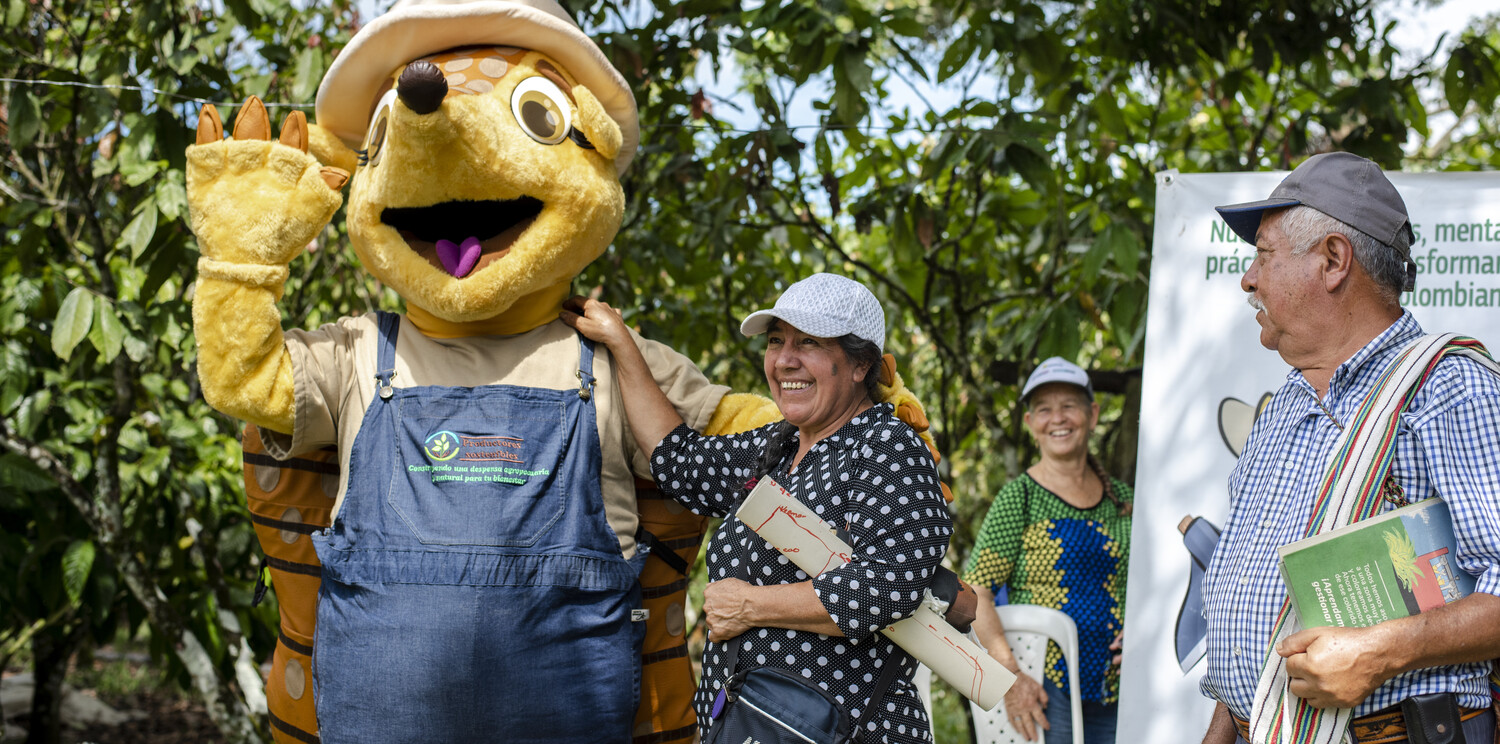
Rare seeks to transform and reimagine how we farm for the future. Through our regenerative agriculture work in Colombia, we partner with farming communities in high-biodiversity ecosystems to shift to regenerative agriculture and more sustainable ranching practices.
We mobilize extension agents, local leaders, and small-scale farmers to address conservation challenges and inspire community members to become agents for change. Grounding that work in behavioral and social science is what turns one farmer’s experiment into a practice a whole community keeps. That is what community-led conservation looks like on a working farm, and the adoption numbers are where you see it.
Regenerative agriculture FAQs
What crops are best for regenerative farming?
Almost any crop can be grown regeneratively, so the better question is which crops are easiest to start with. What matters more than the crop is the combination: diversity, continuous ground cover, and minimal disturbance.
Perennials like coffee, cacao, and fruit and nut trees are natural fits, since the plants stay in the ground and pair well with agroforestry. Legumes fix nitrogen and make excellent rotation and cover crops. Grains and row crops such as maize and wheat work well with no-till planting and cover cropping between seasons, and pasture managed for rotational grazing counts too.
Why don’t more farmers do regenerative farming?
Some farmers don’t practice regenerative agriculture because the risk lands on the farmer first and the reward arrives later. Soil takes seasons to rebuild, and a family with no financial cushion can’t easily absorb a lean year in between. Access to credit, seed, and reliable technical support is uneven, and farmers who have been burned before by seedlings that died or advice that stopped coming are understandably cautious.
Land tenure matters too, since it’s hard to invest in soil you may not farm in five years. The barrier is less about knowledge than about risk, trust, and support.
What’s better, organic or regenerative?
They answer different questions. Organic is a certification that limits what a farmer may apply to a crop. Regenerative agriculture is an approach defined by outcomes: is the soil healthier, is biodiversity increasing, is the farm more resilient, are the people better off? A farm can be certified organic and still deplete its soil through heavy tillage, and a farm can be deeply regenerative without paying for certification. In practice the two overlap, and the strongest farms borrow from both.
Are soil and dirt the same thing?
Soil and dirt are not the same thing. Although closely related, there are a few distinct characteristics that separate soil from dirt. Dirt is small particles of clay, sand, silt, gravel, and stones. Alone, dirt is not sufficient to grow plants or foster life. Soil is a unique living ecosystem comprised of plants, animals, water, and minerals. Dirt is just one small component of the mixture that makes soil.
What does healthy soil look like?
Healthy soil is vital for life on earth and environmental services like carbon sequestration, nutrient cycling, erosion prevention, and providing habitat for wildlife. Common characteristics of healthy soil include:
- Rich organic matter that gives the soil a dark color.
- Air pockets that allow plants and animals to move freely and distribute nutrients.
- A light, crumbly texture that falls apart when scooped up in your hand.
- Strong plant root systems that secure soil in place and prevent erosion.
What is soil biodiversity?
Soil biodiversity refers to the various life forms found in soil. This biodiversity includes billions of organisms such as bacteria, protozoa, fungi, insects, and small mammals. Biodiversity is critical for soil health, as it supports key ecological services such as nutrient cycling, water filtration, and carbon sequestration.
How much biodiversity is found in soil?
Soil is incredibly biodiverse. More than half of Earth’s biodiversity is found in our planet’s soil. One teaspoon of soil contains more life than the number of people on the planet.
Stay Connected
Sign me up for occasional emails to learn more about Rare’s work and how I can support its mission. I know I can unsubscribe at any time.